Oxford is famous for its prestigious university, but even if you have no intention to study there, it is also worth a day trip to explore its rich history and culture. Going there from London is easy and convenient. A direct train operated by Great Western Railway will take you from Paddington station to Oxford station in under an hour, and then you can take a bus to the city center or walk to the main street in about 15 minutes. Below is the itinerary for you to visit all the top attractions.
1. Broad Street
Begin your journey on Broad Street, home to a slew of important sites that would arouse the interest of history buffs.
A cross of granite setts on the center of the road, Martyrs’ Cross is one of the most well-known monuments in the city, marking the location where the three Protestant Martyrs of Oxford (Thomas Cranmer, Nicholas Ridley, and Hugh Latimer) were burnt at the stake after being tried for heresy in 1555 at University Church of St Mary the Virgin.
Looking up from the cross is the front of Balliol College. Founded in 1263 by John I de Balliol, it’s claimed to be the oldest college out of the 38 in Oxford. It educated Prime Minister Edward Heath, who led the United Kingdom into the membership of the European Communities (which later became the European Union), and, coincidently, Prime Minister Boris Johnson, who did the Brexit in 2020.
At number 50 is the original Blackwell bookshop, now an internationally-known British academic book retailer with 18 branches and around 1000 staff. When it was first opened in 1879 by Benjamin Henry Blackwell, it was merely 12ft square. But now, its expansive Norrington Room boasts more than 160,000 books in 5km of shelving.
2. History of Science Museum

The world’s oldest surviving purpose-built museum, the History of Science Museum is home to a wide range of scientific instruments from the Middle Ages to the 19th century. Even if you are not interested in this field, it would be a shame not to see the Einstein’s Blackboard. In May 1931, physicist Albert Einstein came to Oxford to give lectures on the General Theory of Relativity, and the university meticulously preserved one of the blackboards he used. The equations you see on the board are related to the cosmological model known as the Friedmann–Einstein universe.
4. Bridge of Sighs
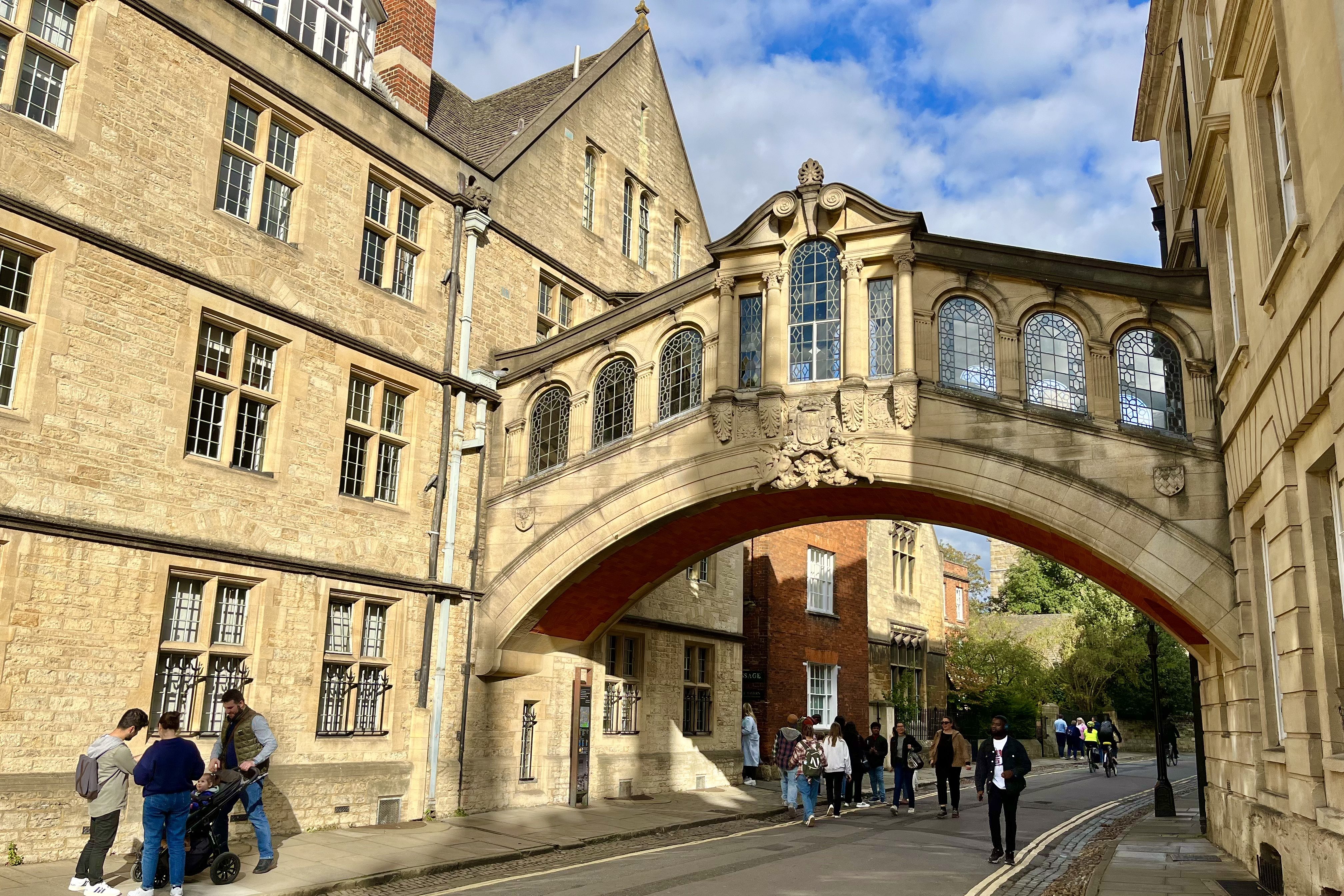
Hertford Bridge, aka Bridge of Sighs, gained popularity as it resembles the namesake bridge in Venice, Italy. Completed in 1914, the skyway links up the new and old quadrangles of the historical Hertford College over New College Lane. Tourists would not be able to cross the bridge, but it’s also a pleasure to admire the architectural jewel from below.
5. Bodleian Library
Housing over 13 million printed items and the second-largest collection of manuscripts and archives in the country from the third century B.C. to modern days, Bodleian Library is the main research library of the University of Oxford. It’s also a legal deposit library, meaning it is a requirement for all the work published in the UK to send copies there. The bronze statue in front of the main entrance is William Herbert, 3rd Earl of Pembroke, who donated an enormous amount of manuscripts to the library in 1629, while the initials of the library founder Thomas Bodley are embossed on a rain-water pipe on a wall.
6. Radcliffe Camera
The focal point and one of the most magnificent structures of the university, Radcliffe Camera serves as a reading room for the Bodleian. Though it’s called the Camera, it doesn’t look like one and has nothing to do with photography. The name is derived from the Latin word “camera”, meaning “room”. The Baroque-style building is, unfortunately, not open to the public, so you can only marvel at it from the Radcliffe Square or at the top of the University Church of St Mary the Virgin.
7. University Church of St Mary the Virgin

Opposite the Radcliffe Camera, the English Church is the spiritual heart of Oxford and was adopted as the first building of the university, used for lectures and the award of degrees by the early 13th century. Entering the church, I was serenaded by ethereal music as an orchestra was practicing in front of the altar. The audience sitting on the pews was captivated by the performance while I climbed up to the gallery to have a bird-eye view of the house of worship. Before leaving, make sure you ascend the 127 steps to the tower to take in the 360-degree view of the city.
8. Narnia Door (St Mary Passage)

If you are a fan of The Lion, the Witch, and the Wardrobe written by C. S. Lewis, who was a fellow and tutor in English Literature at Magdalen College in Oxford University, you shouldn’t miss the Narnia Door located on the St Mary Passage. Claimed as the inspiration for the famous children’s novel, the door is adorned with features that assemble the Lion Aslan and Mr. Tumnus. When Lucy Pevensie entered the magical world of Narnia inside the wardrobe, she discovered a lamp post. Coincidently, a lamp post is standing a few steps away from this Narnia Door.
9. Christ Church College
It is the most visited college by tourists in Oxford, not because it has educated 13 Prime Ministers in history but because it was the filming location of some of the Harry Potter scenes, and its Dining Hall mirrors the Great Hall in Hogwarts. Another distinguished literature linked to this college is Alice’s Adventures in Wonderland, of which the author, Lewis Carroll, attended Christ Church College and the leading character was inspired by the eponymous daughter of the Dean, Henry George Liddell. Make sure you book the entry ticket in advance to secure a spot.
 Crystal on the journey